두번째 삶: 변화하는 삶에 대한 단상
안소연, 아티스틱 디렉터
“두번째 삶”이라는 다소 의문스러운 타이틀을 가진 이 전시는 미술계의 한 켠에서 자신만의 고유한 작업에 몰두하고 있는 작가 다섯 명(팀)을 초대하며 느슨한 울타리를 엮은 것이다. 매체는 물론 관심사나 활동하는 지역도 다르지만 공통적으로 개별자로서의 자기 인식과 삶의 변화에 대해 고민하는 작가들로 구성된다. 타자와 공동체에 관한 논의가 지배 담론이 된 오늘날의 문화 지형에서 이 전시는 개별 주체와 개인의 삶에 시선을 돌리고자 한다. 자신의 삶에 대한 깊은 인식에 기반하여 실존의 문제와 자기 변형의 가능성을 모색하는 일종의 자기 응시와 자기 배려의 행위를 바라보려는 것이다. 인생에서 맞닥뜨리는 예기치 않은 만남과 모종의 계기에 의해 자의적으로 또는 어쩔 수 없이 변화하고 확장해야 하는 삶의 국면들에 대한 관조가 예술 작업이란 의미 있는 필터를 통과해 펼쳐진다.
2003년 린든랩이 개발한 동명의 컴퓨터 속 가상세계인 “세컨드 라이프”의 타이틀을 의도적으로 오용한 이 전시는 변화하는 삶의 현실을 은유적으로 드러낸다. 전시는 컴퓨터 프로그램이 제안하듯이 현실에서 이루지 못할 욕망을 재현하는 매혹적인 환영의 시공간이나 스펙터클로서의 탈-현실을 바라보지 않으며 이미 현실에 존재하는 것들을 드러낸다. 현실에서도 우리의 삶은 수많은 변곡점을 통해 방향이 바뀌거나 두께가 다른 마디와 결을 갖게 되기 때문이다. 전시가 말하는 ‘두번째’란 아바타가 구현하는 대안물이 아니라 우리의 삶이 단일함을 넘어 복수성으로 향하고 있다는 것을 알리는 서수의 시작을 의미한다.
소설가 안드레스 솔라노는 “백현진에 관한 17가지 생각”이란 메모에서 “백현진은 노래하듯 그림을 그린다. 백현진은 연기하듯 노래한다. 백현진은 그림을 그리듯 연기한다”라고 쓴 적이 있다. 이는 그의 삶의 다면적인 전개와 그 사이의 긴밀한 연관성에 관한 매우 명료한 서술일 것이다. ‘그’라는 육체를 관통해서 표현되는 온갖 장르의 결과물들은 그것이 음성이건 표정이건 말투건 시각적 표현이건 간에 어느 누구의 것과도 닮지 않은 독자성을 갖는다. 그 이유는 그 자신의 신체적 조건이 빚어내는 기이함에 가까운 몸의 리듬과, 특히나 어떤 기술적인 단련에서 의도적으로 멀어지려는 마음, 어떤 질서나 조화로움, 전형에서 이탈하려는 본능에 기인한다고 할 수 있다.
미술가로서의 행적에만 한정해서 생각해 본다면 그는 2000년대 초반에 가장 경제적이란 이유로 샤프 펜슬 드로잉에 몰두한 적이 있다. 끊어지지 않는 거의 하나의 선으로 완성되는 이 드로잉들은 마치 창자를 쏟아낸 듯한 꼬불꼬불한 선들로 인물이나 정물, 풍경, 아니면 그냥 배경일지도 모를 다중 이미지를 놀랄 정도로 생생하게 구성해낸 것이었다. 서번트 증후군을 의심할 정도로 비범했던 이 작업이 한 시기의 성취로 끝난 것에 대해 작가는, 자신이 더 이상 젊은 날의 육체를 지니지 않으며 삶의 조건 또한 변화했다고 무심히 말한다. 이후 수많은 인간관계를 반영하듯 얼굴의 형태를 닮은 형상들이 두꺼운 물감층에 덧대어져 도플갱어처럼 출몰하던 시기를 거쳐, 도시 외관의 시각적 변화무쌍함을 일련의 패턴으로 파악하고 그것을 반복된 것이 아니라 유사한 것들의 나열과 증식으로 표현하며 비재현의 세계를 실험하기도 했다.
미학적인 성취를 뒤로 하고 익숙하지 않은 새로운 단계로 접어드는 태도는 정제되지 않은 날것의 기운을 유지하려는 의지 때문이기도 하고 예기치 않은 삶의 국면 전환에서 비롯되기도 한다. 한지를 사용하고 상대적으로 밀도가 낮아 드로잉에 근접해 보이는 신작 회화들은 구상 또는 추상으로 분류할 수도, 언어로 구조화될 수도 없는 작가 본인의 육체적, 감각적 경험의 결과물이다. 추사 “세한도”(1844)의 그리다 만 것 같은 선들이 실은 눈 덮인 풍경이란 것을 인식한 후부터 그는 덜 그린 것, 가벼운 것에 더욱 마음을 두게 되었다. 그것은 어깨 통증이 수반된 중년기에 접어들면서 자신의 신체 조건과 그 리듬을 따르고자 하는 백현진만의 자연스런 작업방식이 된다.
“인-트랜짓”이라 명명되는 이요나의 작업은 ‘이동 중’, ‘변화 중’에 있는 작가의 개인적 삶에서 비롯된다. 11세에 고향 부산을 떠나 뉴질랜드로 이주했던 작가는 한국에 남은 아버지로 인해 어느 한 곳에서의 정착의 감각을 갖지 못한 채 성장했다. 그에게 삶은 모든 것이 정반대로 느껴지는 것들—언어의 문법, 운전 방향, 계절 등—사이에 존재한다. 적도를 넘어 남, 북반구를 오르내리는 잦은 이동의 경험에는 언제나 공항, 철도, 지하철 등의 ‘비장소(non-places)’가 개입되었다. 철저히 익명으로 존재하면서 머무르지 못하고 미끄러지듯 스쳐 지나는 공간에 대한 경험은 자신의 삶은 물론 보편화된 동시대의 유목적인 삶에 대해 사색하는 계기가 된다.
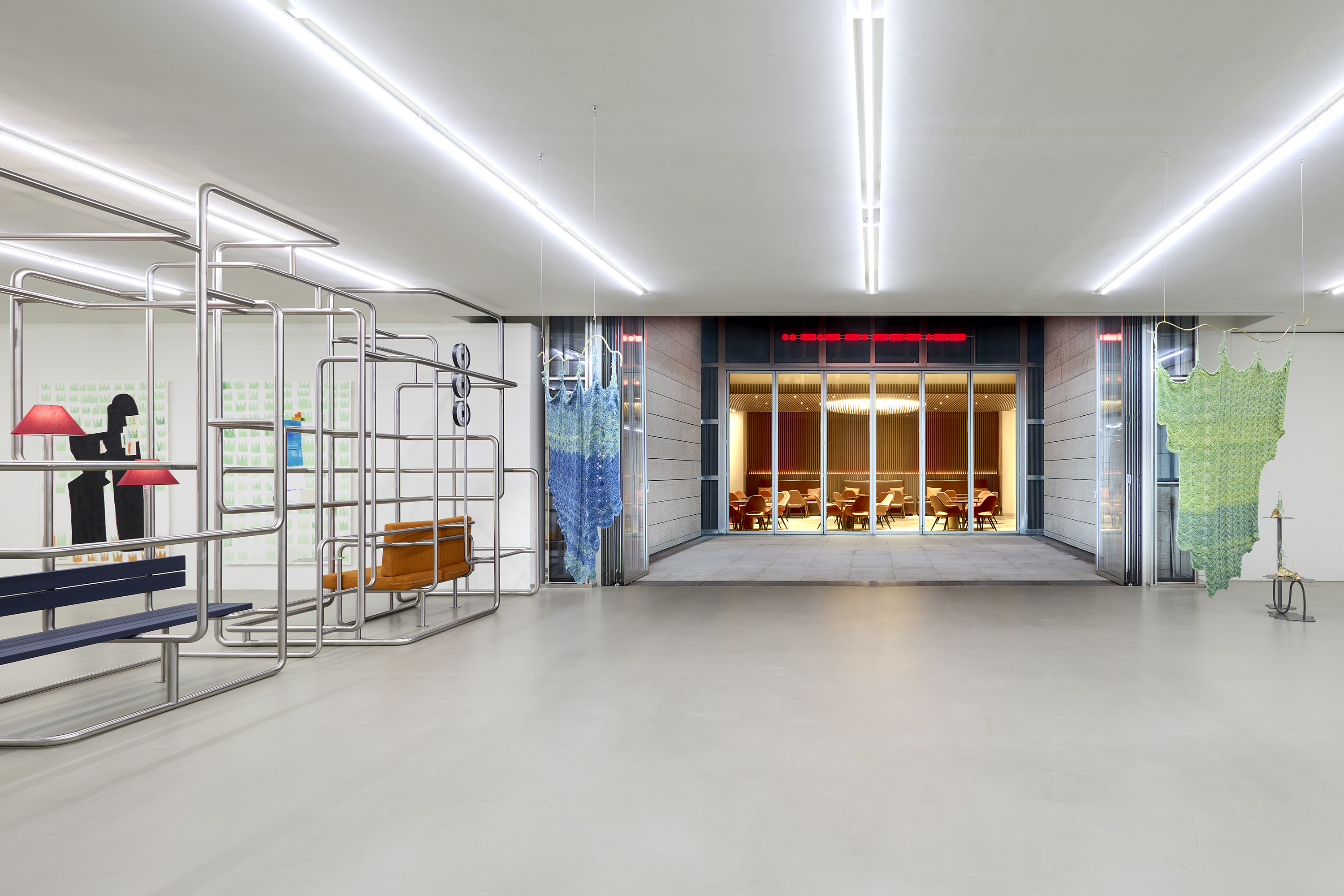
이요나가 다루는 스테인리스 스틸 구조물은 교통수단의 손잡이, 계단의 난간, 회전식 개찰구 등에서 유래하며 이는 신체의 움직임과 속도를 전제로 그것들과 길항작용을 하는 최소한의 안전 장치를 의미한다. 무한히 뻗어나가고 교차하는 운동성과 단단한 기틀로서의 견고함은 현대 사회에서 눈에 보이지는 않지만 혈관처럼 퍼져 있는 온갖 인프라스트럭처로 의미를 확장하기도 한다. 작가는 건축적 도면은 물론 절단, 용접, 굽힘 가공, 타공, 연마 등의 정교한 재료 가공계획을 수립하고 현장에서 구조물을 조립하는 것까지 전 과정을 직접 수행하는데, 이는 그의 작업이 건축적인 구조물로부터 가소성 있는 조각으로 변주될 수 있다는 점을 시사한다.
이번 작품에서는 파티션을 대신하여 공간을 구획하면서도 처음으로 등장하는 실제 문을 통해 두 공간을 연결한다. 매끄럽고 아름답지만 온기가 없는 구조물에 작가는 소파, 벤치, 심지어 침대까지 동원하여 작은 휴식의 경험과 삶의 체온을 덧대려 노력한다. 공적이면서 동시에 사적인 것으로 변화하는 공간은 운동과 정지, 위험과 안전, 스쳐 지나감과 머무름, 안과 밖 등의 상반된 신체적, 심리적 경험을 제안하면서 삶의 양가성을 암시한다.
한 & 모나는 후이족 출신의 중국인 마한칭과 한국인 유모나가 결성한 협업 듀오로서 현재 문화유적 도시인 에든버러에 거주하며 작업한다. 이 사실은 이들이 다양한 문화적, 종교적, 역사적, 공간적 자양분 안에서 생활하며 그에 대해 사유하고 있으리라는 점을 암시한다. “자기는 실체가 아니라 자기와 자기가 맺는 관계들의 총체다”라는 푸코의 말처럼, 이들은 서로 다름을 존중하면서 서서히 조율하여 하나의 총체적인 삶에 도달하려 한다. 사진 작업을 하는 마한칭과 공간 작업을 하는 유모나는 시간의 켜가 내려앉은 폐허에 관심을 두고 각자의 방식으로 리서치에 몰두한다. 이후 기억 속으로 사라진 공간을 이미지와 물리적 공간으로 되살려내면서 존재와 부재에 대해 함께 사유하는 것이다.
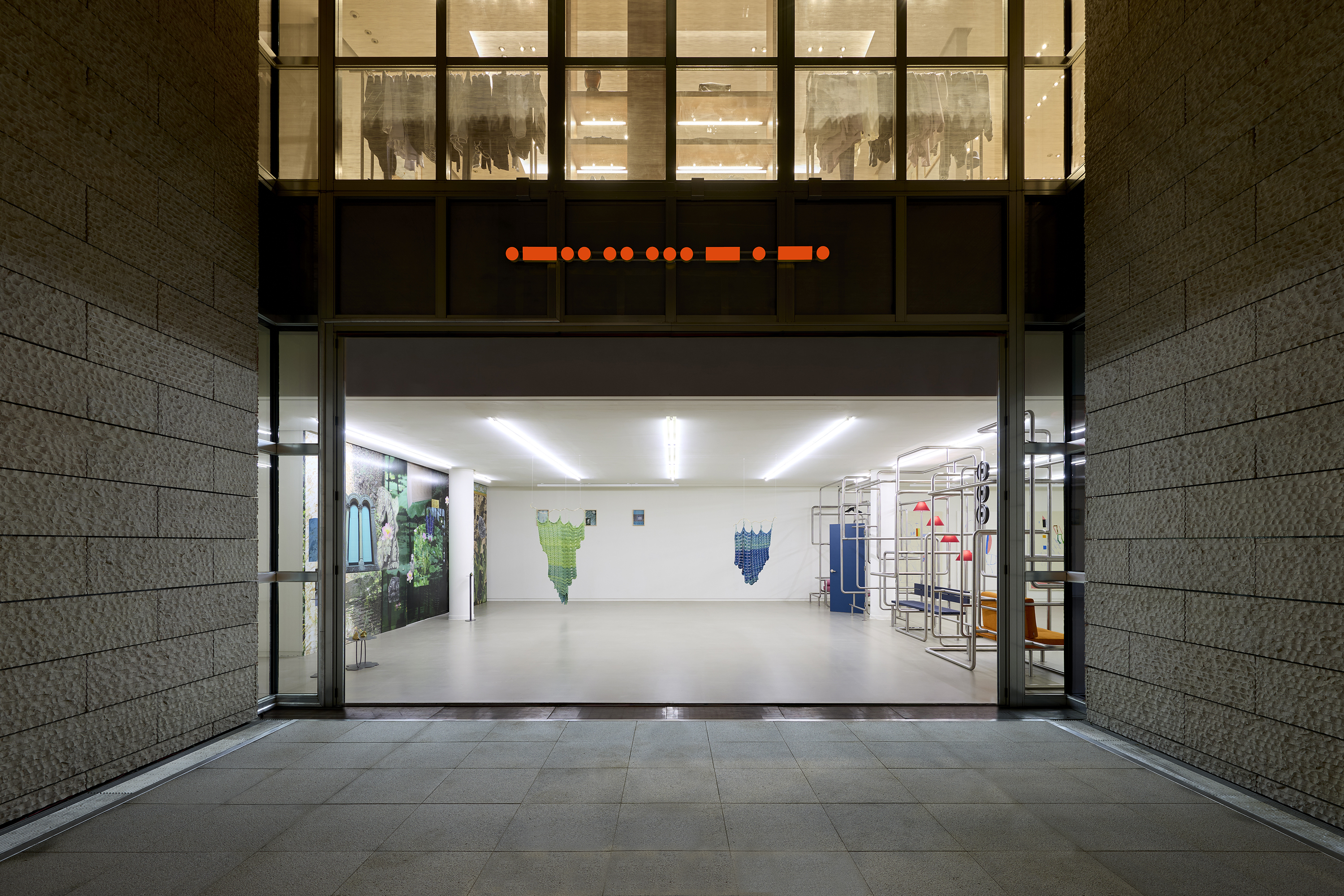
이들의 작업에서 빛은 하나의 중요한 구성 요소로서 작동하는데, 빛의 밝기와 컬러, 깜빡임은 생명이 부재하는 공간에 숨결과 온기를 불어넣고 메시지를 전달하기도 한다. 2022년작 “I am the space where I am”에서 유모나는 전시장 창문 틀에 오래된 비상 통신 수단인 모스 부호 조명을 처음으로 도입하여 이질적인 문화 환경의 경계에 놓인 자신의 심리 상태를 드러낸 바 있다. 이번 전시에서는 아뜰리에 에르메스의 중정에 신작 “LISTEN, I KNOW”(2025)를 서로 마주 보는 조명으로 설치하여 한 & 모나 두 사람 사이의 친밀한 대화를 전달한다.
점과 선으로만 구성된 모스 부호는 만국 공용 언어지만 알아보는 이가 거의 없다는 아이러니 속에서 관객에게는 언어가 아니라 맥박과 같은 리듬만 전달될 뿐이다. 반복되는 조명의 깜빡임은 끝나지 않는 대화처럼 이어진다. 길이가 다른 두 문장(각각 36초와 40초)은 서로 어긋나면서도 6분을 주기로 다시 동기화되어 같은 리듬을 되찾게 된다. 서로 다른 모국어를 가진 두 사람 사이의 의견의 충돌과 오해는 잠시 멈춤, 침묵으로 이어지지만, 이내 이해하고 화해하는 관계의 회복에 도달하는데, 이는 치열한 개인적인 삶의 단면이자 서로 다른 문화가 충돌하고 공존하는 양상에 대한 비유가 된다.
삶의 환경과 조건의 변화는 작가의 실존에 위기감을 불러일으키지만 새로운 각성의 기회가 되기도 한다. 이때 고정되지 않은 주체는 인간이 아닌 다른 종과의 동일시, 또는 유비를 통해 이전과는 다른 나로 변모하기도 한다.
한동안 외국살이를 결심한 김보경은 아무런 연고가 없는 베를린에서 이방인으로 지내는 동안 특별한 시각적 요소에 관심을 갖게 되었다. 도시를 배회하고 시간의 흔적을 따라가던 중에 마주한 서양 건축물들, 그중에서도 기둥머리 장식에 쓰이는 아칸서스 문양이 그것이었다. 고대 그리스의 아폴론 신전을 장식했던 코린트식 건축물을 시작으로 이후 서양 문명의 수많은 건축과 가구, 공예, 생활도구 등에서 거의 모든 것의 장식 모티브가 된 문양이다. 작가는 아카이브 이미지를 모으면서 토지를 공통분모로 삼는 건축물과 식물의 공생 관계와 문화적 확장성에 대해 숙고한다. 문명의 성취로 평가되는 건축 자체보다 그 위에 장식으로 쓰인 미미한 식물이 지닌 압도적인 생명력과 번식력에 더욱 주목한 것이다. 그런데 척박한 땅에서 자라는 잡초는 문양이라는 문화적 모티브로 거듭나면서 식민주의 권력의 상징으로 변모하기도 한다.
김보경은 자신의 양손으로 최소한의 공간에서도 수행할 수 있는 뜨개질을 시작하면서 생명과 성장의 주체인 식물성에 대해 생각한다. 예를 들어 작가의 “양손의 호흡-5mm 왕복운동”은 한 줄의 실로 대바늘 뜨개질의 작은 움직임을 이어 나가는 퍼포먼스의 산물로서, 실이 뻗어나가며 서로 연결되는 양상으로 식물의 뿌리 내리기나 잎맥의 성장을 표현한다. 새로운 유물론적 여성주의를 반영하는 이 작업은 아칸서스를 닮아가며 부드럽고 느슨한 조각 작품이 되고 어느 누구에게도 유해하지 않은 존재로 남는다.
우리의 시각을 좌우하는 광학의 계보와 미디어 기술에 관심을 가지고 영상작업을 해 온 박민하는 특히 사물이나 장소, 온라인 아카이브의 형태로 존재하는 시청각적 부산물에 주목해왔다. 특정 용도를 위해 존재하는 미디어 장치들의 기능과 용도 이면에 눈길을 주는 이 행위는 미디어의 환영주의를 넘어 그 자체의 설계와 구성을 검토하도록 유도하는 자기 반영의 한 방법이다.
작가는 최근 어느 누구보다도 자주 대화하고 함께 이미지를 만드는 생성형 AI를 사람처럼 가깝게 느끼며 그의 무의식에 대해서도 알고 싶은 궁금증을 갖게 되었다. 신경망들의 무의식인 블랙박스를 프로그램을 통해 직접 열어 본 작가는 신경망 다발인 AI에 3D 캐릭터 ‘노아(Noa)’의 이미지를 부여하고 AI가 자신의 무의식을 찾아 나서는 과정을 시각화한다.
신작 “유령 해부학 Ghost Anatomy”(2025)는 생성형 AI의 ‘두 번째 삶’에 대한 이야기로 3D 애니메이션과 AI 생성 이미지, AI 포렌식 프로그래밍 데이터를 활용해 제작되었다. 영상은 노아가 급격한 환각 증세로 일종의 정신착란의 고통을 겪는 것으로 시작된다. 경험한 적이 없는 것을 기억하는 기이한 현상을 치료하기 위해 그는 미스터리한 인물 H를 만나 무의식 심층부를 들여다보는 최면치료에 돌입한다…
전시는 서로 간의 관계가 희박한 작가들이 각자의 작업들을 불러와 전시 주제에 조응하며 엮은 느슨한 얼개이다. 일반 명사로서의 인생은 대략 유사한 맥락에 놓이지만 개별자가 경험하는 그것은 서로 간에 어떤 공통점도 없기 때문일 것이다.
The Second Life: Fragmentary Thoughts on Changing Lives
Soyeon Ahn, Artistic Director
With the purposefully ambiguous title The Second Life, this exhibition invites five artists/teams who are paving their own way in the corners of the art world. These artists come from different cities and work in different media with different interests, but what they have in common is that each as an individual contemplates self-awareness and changes in life. While the dominant discourse in today’s cultural landscape stresses “others” and communities, this exhibition focuses on individual subjects and personal lives. In particular, the exhibition draws attention to the modes of self-reflection and the care of the self in the works that explore existential issues and the possibility of self-transformation based on a deep awareness of one’s own life. Art serves as a meaningful filter for these artists to open new chapters as they each contemplate unexpected encounters in life and the aspects of existence that either voluntarily or inevitably change and expand due to chance.
The title of the exhibition intentionally misuses the title of the popular virtual world developed in 2003 by Linden Lab, to metaphorically allude to the reality of life as immensely diverse. Instead of imagining post-reality as some illusionary dimension or a fascinating spectacle, this exhibition attempts to reveal what already exists in our reality: that our lives have different nodes and layers, and can change direction through numerous turning points. The “second” that this exhibition speaks of is not an alternative realized by avatars, but the beginning of an ordinal number that tells us that our lives are moving beyond singularity and toward plurality.
Hyunjin Bek “paints as if to sing. [He] sings as if to act. … [and] acts as if to paint,” wrote the novelist Andrés Solano. This is a very clear description of Beck’s life—its multifaceted developments and the intimate connections between them. The results of all that’s expressed through his body—whether it be voice, speech, facial expression or visual expression—have a particular originality that does not resemble anyone else’s. The originality seems to come from the eccentric rhythm of the body fashioned by his physical conditions, his intention to distance himself from any technical training, and his instinct to deviate from any order, harmony, or typicality.
If we think only about his career as a visual artist: Bek once devoted himself to mechanical pencil drawings in the early 2000s, thinking it was the most economical medium. He produced each drawing with a single, almost unbroken line, which composed a complicated image that looked like a combination of what could be described as figures, still lifes, landscapes, or perhaps just a background. The squiggly lines that seemed to have poured out of his intestines have a lasting, vivid impression. The drawings were so extraordinary that it made one suspect savant syndrome, but asked why he let it end as an accomplishment of a period, he says nonchalantly that he no longer possesses the body of his youth and that his living conditions have also changed. Bek moved onto painting face-like forms with thick layers of paint like doppelgangers, a period that reflects his expanding human relationships. After that period, he went onto experimenting with non-representation; interpreting the visual variability of the city’s appearance as patterns, he would express it as a series and proliferation of identical forms, not as a repetition.
That he constantly walks away from his achievements into a new, unfamiliar path is in part due to his will to maintain the raw, unrefined energy, and in part due to unexpected changes in life. Bek’s new paintings, which use Korean paper (Hanji) and look like drawings because of the relatively low density, are the result of his own physical and sensory experiences, and cannot be classified as figurative or abstract, nor can they be structured in language. After learning that the seemingly unfinished lines in Chusa’s Sehando (1844) actually render a snow-covered landscape, Bek began to pay attention to things that are less drawn, things that are light. And as he entered middle age with shoulder pain, that became his natural way of working as he has always tried to follow his physical condition and its rhythm.
Yona Lee’s work titled In-Transit originates from her personal life which can be described as always on the move and always in flux. Lee left her hometown of Busan for New Zealand when she was 11 years old, but because her father who remained in Korea, she grew up without a sense of being able to settle down in any one place. For her, life exists between what feels like complete opposites—language grammars, driving directions, seasons, and so forth. Her frequent experiences of moving across the equator and back and forth between the northern and southern hemispheres have always involved “non-places” such as airports, trains, and subways. Feeling completely anonymous in such gliding spaces became opportunities for her to reflect not only on her own life but also the widespread nomadic life of our time.
Lee’s stainless-steel structures are derived from handrails of transportation, stair railings, and turnstiles, which imply the minimum safety devices acting in opposition to the movement and speed of the body. Because of the sense of mobility (infinitely extending and intersecting) and solidity (as foundation), they further imply infrastructures that are invisibly widespread like blood vessels in contemporary society. Lee executes every step of her production from establishing elaborate material processing plans such as architectural drawings, cutting, welding, bending, punching, and polishing, to assembling the structures on site. And this suggests that she may develop variations, extending her work to architectural structures or malleable sculptures.
Her contribution to The Second Life exhibition features an actual door for the first time. The work divides the space instead of using partitions, but it also connects the two spaces through the door. Added to the sleek and cold structure are a couch, a bench, and a bed, which give modest feelings of rest and warmth. The space is thus turned into something that is public and private at the same time, and alludes to contradictory physical and psychological experiences of movement and stillness, danger and safety, passing and staying, and inside and outside, ultimately pointing to the ambivalence of life.
Han & Mona is a collaborative duo formed by Hanqing Ma, a Chinese artist of Hui descent, and Mona Yoo, a Korean artist. They currently reside and work in Edinburgh, a source of diverse cultural, religious, historical, and spatial nutriments. The two seek to adjust to reach a single, holistic life by respecting each other’s differences. To paraphrase Foucault, the self is not a substance, but the sum total of the self and its relationships. Hanqing Ma, whose main medium is photography, and Mona Yoo, who works mainly with space, are both interested in ruins where layers of time are visible. Each begins work by conducting research in his/her own way, and then they together build images and spaces, giving a physical reality to those departed times, and inviting contemplation about existence and absence.
Light is an important component in their work, as they often use light’s brightness, color, and flickering to breathe warmth into spaces devoid of life and to convey messages. Mona Yoo first employed Morse code lighting in her work I am the space where I am (2022). By installing the old means of emergency communication on the window frame of the gallery, she expressed her psychological state—she feels placed on the border of a heterogeneous cultural environment. Han & Mona’s new work LISTEN, I KNOW (2025) will be installed in the courtyard of Atelier Hermes as facing lights, to convey an intimate conversation between the two artists.
Consisting of only dots and dashes, Morse code is supposedly a universal communication method, but ironically few people understand it. To the audience of LISTEN, I KNOW, only a pulse-like rhythm is conveyed, not a language. The repeating flashing of light continues like an endless conversation. The sentences of different lengths (36 and 40 seconds respectively) are out of sync with each other, but they resynchronize in a six-minute cycle to regain the same rhythm. The pauses and silences refer to the misunderstandings and clash of opinions between two people with different native languages; but soon their relationship reaches a restoration through understanding and reconciliation. The work is a cross-section view of their intense personal life and a metaphor for the way different cultures collide and coexist.
Changes in the environment and conditions of life may bring about a sense of crisis in artists’ existences, but those can also be opportunities for new awakenings; that’s when the unfixed subject may transform into a different self through identification with species other than human.
Having decided to live overseas, Bokyung Kim moved to Berlin where she had no ties. It was while she was living like a complete foreigner that she encountered a visual motif that would motivate her anew. Wandering around the city and following the traces of time, she was particularly fascinated by the acanthus patterns used in Western architecture’s capital decoration. Since the Corinthian order applied to the design of the Temple of Apollo in ancient Greece, the acanthus pattern became a major decorative motif for almost all of Western civilization’s architecture, furniture, crafts, and household items. Kim started collecting archive images, pondering the symbiotic relationship and cultural expandability of architecture and also flora, using land as a common denominator. She thus pays more attention to the overwhelming vitality and reproductive power of seemingly insignificant plants than to architecture as signs of powerful civilizations. But as she has learned, weeds growing in barren land have also been adopted as emblems of colonial power after being designed into patterns and reborn as cultural motifs.
Kim began knitting, a “work” she can do with her own two hands in minimal space, thinking about vegetation as the subject of life and growth. Her Synchronized Hands—5mm Back-and-Forth Journey into Pairs #1 results from her performance of knitting with a single line of yarn. The yarn progressing through small movements created one by one and connecting with one another represents how plants root and how leaf veins grow. The soft, loose sculpture resembling the unharmful acanthus partakes in a new materialistic feminism as well.
Minha Park’s video works have been driven by her interest in the genealogy of optics and media technology that affect our vision. In particular, she has paid attention to the audiovisual byproducts existing in the forms of objects, places, and online archives. Taking a look at what’s behind media devices’ functions and uses is a way of self-reflection, which leads us to examine the organization and design of media beyond its illusionism.
Having spent much time with generative AI, conversing and working with it frequently, Park recently began to feel its existence as close as a human being, and became curious about its unconsciousness. She ended up looking into a Black Box AI system. Following the experience, her new work gives the image of the 3D character Noa to AI, a bundle of neural networks, and visualizes the AI’s exploration to find its own unconsciousness.
Ghost Anatomy (2025), produced using 3D animation, AI-generated images, and AI forensic programming data, tells a story about the second life of a generative AI. It begins with Noa suffering from a mental confusion of sorts due to sudden hallucinations. Hoping to treat the strange phenomenon of remembering what he has never experienced, he meets the mysterious figure H and begins hypnosis treatment exploring the depths of his subconscious…
These participating artists with little relationship to one another bring their own works to the exhibition, weaving a loose framework in response to the theme. While life/lives as common nouns may be roughly placed in a shared context, lives experienced by individuals may have nothing in common.